
Ask a room full of men how tall they are, and a surprising number will say six feet. Ask a tape measure and the answer often changes. Being 6 feet tall is far less common than most people assume, and how rare it is depends heavily on where in the world you happen to be standing. In the Netherlands, it is commonplace for a man. In India or Indonesia, it is a genuine rarity.
This guide puts real numbers behind the question. You will see what share of men and women reach six feet in different countries, why some populations are so much taller than others, and what the height means in daily life. It also shows how to find your own percentile, so you can judge where you really stand instead of relying on guesses.
What Six Feet Actually Means in Numbers
Six feet is 72 inches, or about 182.9 centimeters. That sounds like a tidy round number, but it lands in a very different place on the height curve depending on the population. Adult height follows a bell shape. Most people cluster near the average, and fewer and fewer people appear as you move toward the extremes. The share of people above six feet depends on two things: the group’s average height and how widely heights are distributed around it.
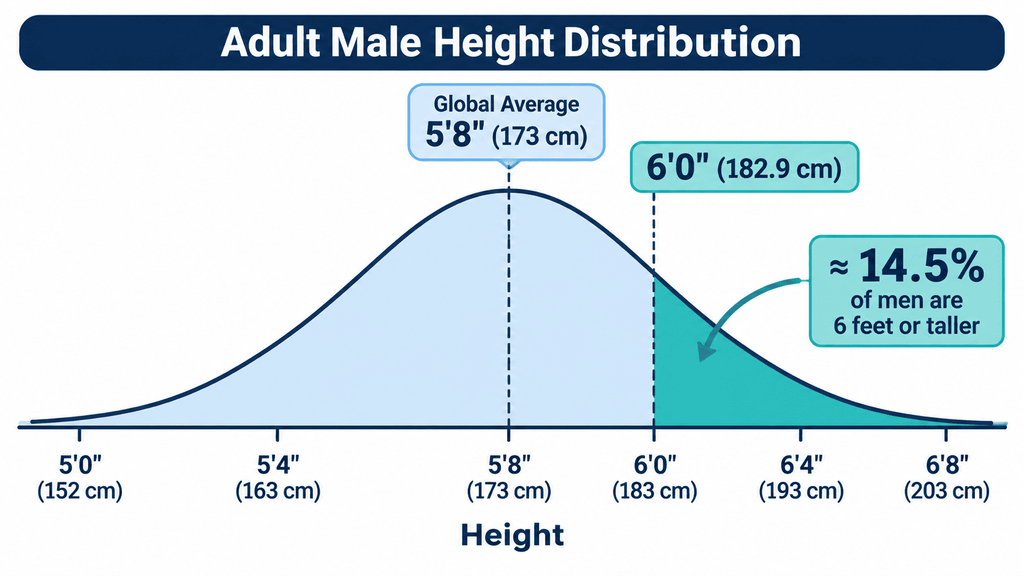
For men worldwide, researchers put the average at roughly 173 centimeters, or about 5 feet 8 inches. That means six feet sits about ten centimeters above the global male average. In a country where the average is closer to 165 centimeters, six feet is a long way up the curve. In a country where the average is 184 centimeters, it is right in the middle.
How Rare Is Being 6 Feet Tall for Men?
In the United States, about 14.5 percent of men are six feet or taller, which works out to roughly one in seven. That figure is widely repeated, and it matches what you get when you run the numbers on the national average of about 5 feet 9 inches. Put another way, if you stand in a crowd of 100 American men, you should expect around fourteen or fifteen of them to be six feet or more.
Worldwide, the share is much smaller. One commonly cited estimate puts it at about 5 percent of men, and a simple statistical model built on the global average suggests somewhere between 5 and 8 percent. Either way, being 6 feet tall puts a man roughly in the top one in twelve to one in twenty across the planet.
The Netherlands sits at the other extreme. Dutch men are the tallest in the world, with an average of about 183.8 centimeters, or 6 feet 0.4 inches. When the average is that close to the six-foot mark, roughly half of men are above it.
Why Self-Reported Height Misleads
Part of the confusion comes from how people report their own height. In a well-known Gallup survey, the tallest third of men reported being six feet or taller. That is far higher than the measured share in the United States. People tend to round up, and many have not been measured since their teenage years. If you want an honest comparison, use a measured number, ideally taken in the morning without shoes.
Being 6 Feet Tall by Country: A Comparison Table
The table below shows average male height for several countries and the estimated share of men who are six feet or taller. The averages come from large international height studies. The shares are estimates calculated from those averages using a normal distribution with a standard deviation of about 7 centimeters, and the United States result lines up with the widely reported 14.5 percent figure.
| Country | Average male height | Estimated share of men 6 ft or taller |
| Netherlands | 183.8 cm (6 ft 0.4 in) | about half |
| Denmark | 181.4 cm (5 ft 11.5 in) | about 40 percent |
| Germany | 179.9 cm (5 ft 11 in) | about 33 percent |
| United Kingdom | 177.8 cm (5 ft 10 in) | about 23 percent |
| United States | 175.5 cm (5 ft 9 in) | about 14.5 percent |
| Japan | 170.8 cm (5 ft 7 in) | about 4 percent |
| Mexico | 169.0 cm (5 ft 6.5 in) | about 2 percent |
| India | 164.9 cm (5 ft 5 in) | about 0.5 percent |
| Timor-Leste | 160.1 cm (5 ft 3 in) | about 0.1 percent |
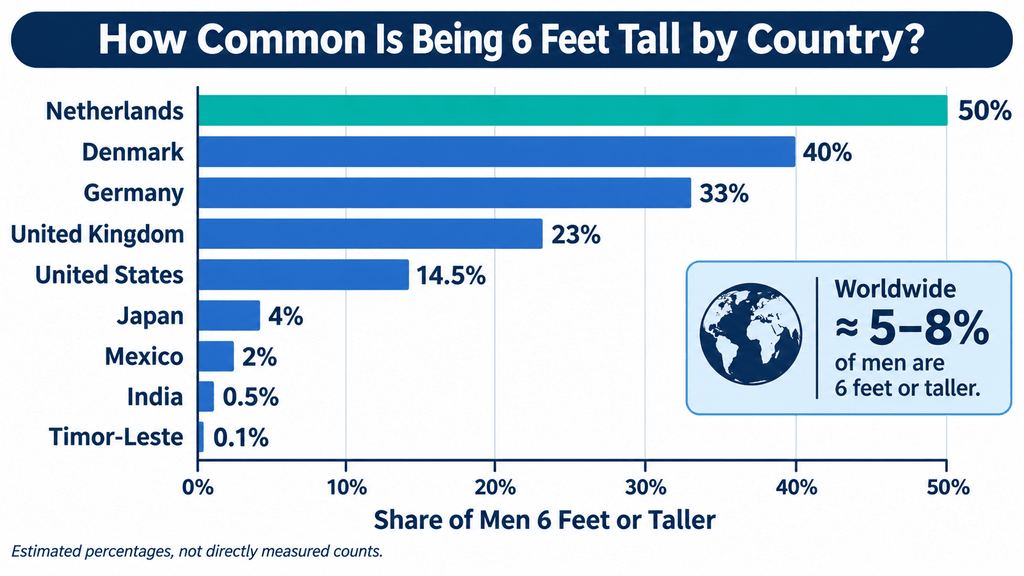
The gap between the top and bottom of the table is striking. Dutch men average nearly 9 inches taller than men in Timor-Leste, the country with the shortest average height. Averages vary slightly across studies and over time, so treat each figure as a good approximation rather than an exact count.
The pattern is easy to read. Northern and Central Europe sit at the top, with large shares of men over six feet tall. Much of East Asia, Latin America, South Asia, and Southeast Asia sit lower, and in several of those regions fewer than one in a hundred men reach the mark. A man who is exactly six feet is just another person in a crowd in Amsterdam, but he stands out in Delhi, Manila, or Lima.
How Rare Is Being 6 Feet Tall for Women?
For women, six feet is much rarer. The tallest women in the world, on average, live in Latvia, where the average is about 5 feet 6 inches (170 centimeters), followed by the Netherlands, Estonia, the Czech Republic, and Serbia. Even there, a woman of six feet is well above the typical figure.
In the United States, the average woman is about 5 feet 3.5 inches tall, so six feet is roughly 8.5 inches above average. Running the numbers, a fraction of one percent of American women reach that height. You will see online claims that about 1% of women are 6 feet tall, but that number seems too high. A one percent cutoff is closer to 5 feet 10 inches for U.S. women. In Latvia, the same model suggests that around two to three percent of women reach six feet, which shows how much the country matters.
This is why very tall women often feel their height more sharply than very tall men do. A six-foot man in the United States is one of about seven. A six-foot woman is closer to one in a thousand, and she may be taller than most of the men around her as well.
Why Some Countries Produce Taller People
Height is shaped by genes, but genes do not explain the size of the gaps between countries. Researchers who analyzed a century of data from about 200 countries described national average height as a signal of nutrition, health care, and the environment people experience from the womb through adolescence. Better food, cleaner water, fewer childhood illnesses, and good prenatal care all add centimeters over a generation.
The same study showed how quickly things can change. South Korean women gained about 20 centimeters over the century, and Iranian men gained about 16.5 centimeters. Meanwhile, parts of South Asia and some sub-Saharan African countries saw little change. Height has also plateaued in many wealthy countries. U.S. men have gained about 2.5 inches over the century, but the nation now ranks around 37th among men, and its average height has barely moved in recent decades.
What Being 6 Feet Tall Looks Like in Everyday Life
Numbers are easier to feel when you connect them to ordinary objects. A standard interior door is about 80 inches high, so a six-foot person clears it by eight inches. Most doors are not a problem. Other parts of daily life are less forgiving. Economy airplane seats, compact car interiors, and showerheads set for average height all start to feel tight as you move past six feet.
Social experience changes as well. Being 6 feet tall in a country where the average man is 5 feet 9 inches earns regular comments, jokes about basketball, and requests to reach high shelves. In the Netherlands, the same height draws far less attention. The measurement is identical, but the social meaning depends on the local average.
Is 6 Feet Tall Considered Tall? It Depends on Where You Are
By global standards, six feet is clearly tall for a man and extremely tall for a woman. By Dutch standards, it is almost exactly average. That contrast explains why people from different countries can describe the same height in completely different ways.
A useful rule is to compare yourself with the people around you. In the United States, a man who is six feet tall is taller than about 85 percent of adult men. In the United Kingdom, he is taller than roughly three out of four. In Japan, he is taller than about 96 percent; in India, taller than about 99 percent. Being 6 feet tall carries the same number on the tape measure everywhere, yet it produces a very different percentile in each place.
How to See Where You Stand
You do not have to guess your percentile. A few simple steps will give you a reliable answer.
- Measure yourself properly. Stand against a flat wall without shoes, keep your heels together, look straight ahead, and have someone mark the top of your head with a flat object. Do this in the morning, since people are slightly taller after waking up.
- Convert your height to centimeters. Multiply inches by 2.54, so 72 inches is 182.9 centimeters.
- Find the average for your country and sex. The national averages in this article are a good starting point, and national health surveys provide more detail.
- Use a height percentile calculator or a height comparison tool. Enter your height and your country to see what share of adults you are taller than.
- Add a reference. Place yourself next to a door, a friend, or a public figure to see the difference visually.
A visual comparison often makes the numbers stick. Seeing your silhouette beside someone five feet five and someone six feet five can say more than a percentile ever will.
Common Myths About Six Foot Heights
Several myths make six feet seem more common than it is. The first is that six feet is average for men. It is the average only in the Netherlands, and a handful of neighboring countries come close. In the United States, it is closer to one in seven men.
The second myth is that most women who say they are six feet really are. As with men, self-reported height tends to run high, and very tall women are rare enough that online claims about their share are often inflated. A third myth is that height is entirely inherited. Genes matter a great deal, but nutrition and health care in childhood help decide how much of that genetic potential is reached.
Conclusion
The honest answer to how common this height is is a range. Being 6 feet tall places a man in roughly the top one in seven in the United States, the top one in twelve to twenty worldwide, and near the middle in the Netherlands. For women, it is rare in every country, with only a small fraction reaching it even in the tallest nations. Heights vary because genes, nutrition, and health care vary, and national averages move slowly over generations. Measure yourself properly, compare with the right population, and you will know exactly how unusual your height really is.
Key Takeaways
- Six feet equals 72 inches, or about 182.9 centimeters.
- About 14.5 percent of U.S. men are six feet or taller, roughly one in seven.
- Worldwide, only about 5 to 8 percent of men reach six feet, while in the Netherlands about half of men do.
- For women, six feet is far rarer, well under one percent in the United States.
- Average height reflects nutrition, health care, and environment as well as genes.
- Self-reported height tends to run high, so use a measured number when comparing yourself.