Scroll through any World Cup lineup graphic, and you will notice something odd. Lionel Messi barely reaches Erling Haaland’s shoulder, yet both men have terrorized defenses at the highest level of the sport. That contrast is exactly why a football players height comparison keeps showing up in search results every time a new tournament kicks off. Fans want to know whether height actually predicts greatness, or whether it is just a fun stat to argue about in group chats.
This article breaks down a full football players height comparison across positions, from the tallest strikers and center-backs to the shortest playmakers who built careers on low centers of gravity. Along the way we will look at why height matters in some roles more than others, how average heights differ across the pitch, and what this all means if you are scouting talent, building a fantasy squad, or just settling a bar argument.
Why a Football Players Height Comparison Actually Matters
Height is not just trivia. In a sport built around aerial duels, one-on-one physical battles, and split-second changes of direction, a player’s frame genuinely shapes how they play. A football players height comparison helps explain why certain teams recruit tall central defenders for set pieces while chasing short, low-center-of-gravity dribblers for the final third.
Coaches think about height in practical terms. A taller goalkeeper covers more of the frame without diving. A towering center-back wins headers at corners. A shorter winger can drop their hips and change direction faster than a defender built for strength rather than agility. None of this means height alone decides outcomes, but it does explain recruitment patterns you see across every major league.
Tallest Football Players in the World Right Now
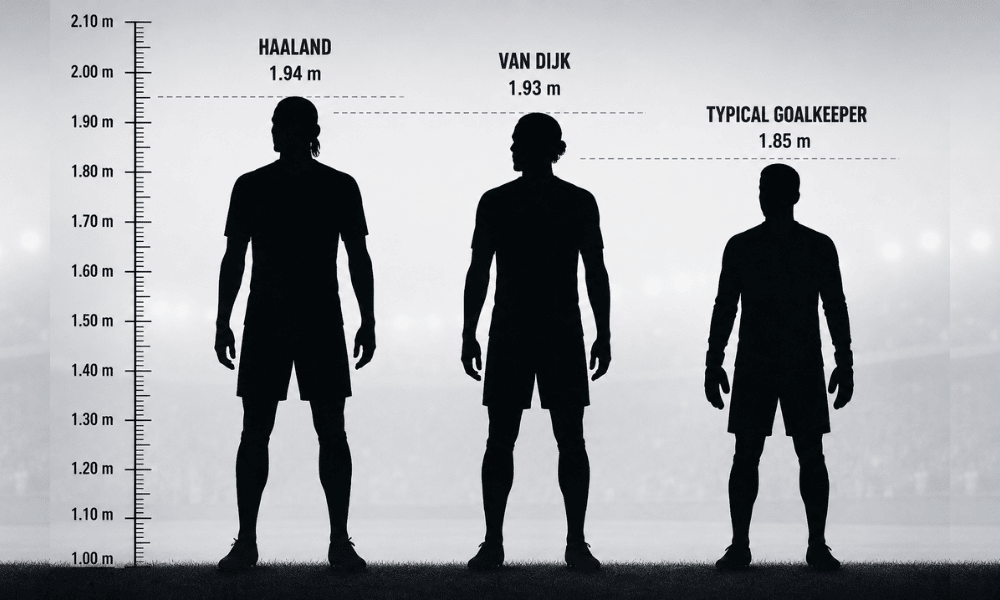
At the top end of the list, you will find Erling Haaland, listed at roughly 195 cm (6’5″). His combination of size and pace is unusual, since most players near that height sacrifice some quickness for physical presence. Haaland stands well above forwards like Lionel Messi and Cristiano Ronaldo, giving him a real edge in aerial duels and crowded penalty areas.
Center-backs and goalkeepers tend to dominate the tall end of the list. Virgil van Dijk stands at around 193 cm (6’4″), a height that lets him win headers against strikers and still cover ground quickly across the back line. Goalkeepers in the modern game routinely measure above 190 cm, since reach at the crossbar has become just as important as reflexes.
Shortest Standout Players and Why They Thrive
The other end of the scale is just as interesting. Lionel Messi, listed at 170 cm (5’7″), built one of the greatest careers in the sport’s history despite being noticeably shorter than most professional footballers. He falls in the roughly 15th to 20th percentile for male height, meaning most men are taller than him.
What makes players like Messi effective is not the absence of a disadvantage; it is how they turn a lower center of gravity into an asset. Tight ball control, quick changes of direction, and the ability to shield the ball at close range all become easier when your body has less distance to shift. This is a recurring theme in football player heights across history, from Diego Maradona to more recent playmakers built the same way.
Football Players Height Comparison by Position
Breaking this down by position gives a clearer picture than looking at individual stars alone.
Goalkeepers
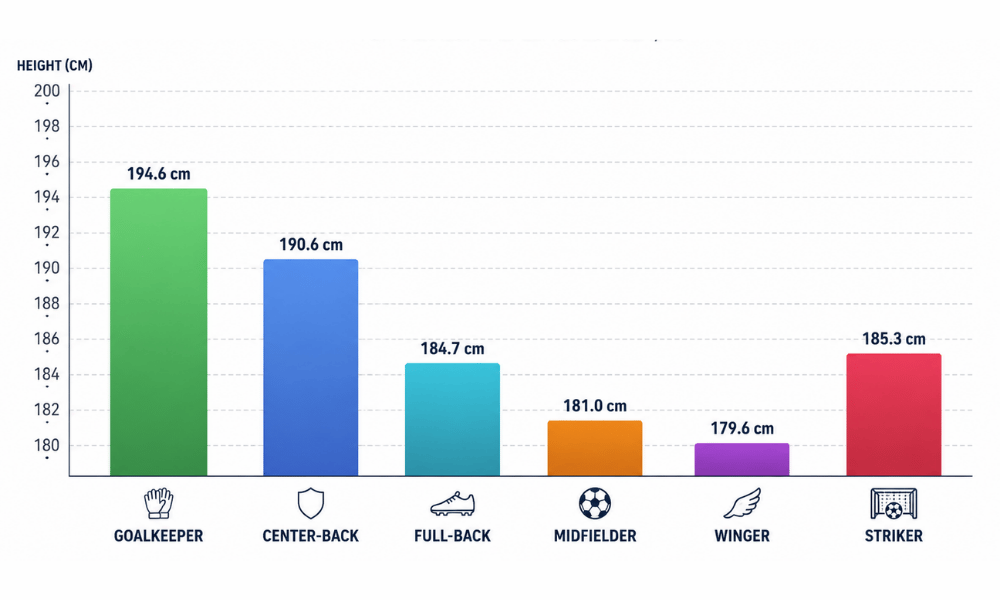
Goalkeepers average close to 188 to 190 cm across the top leagues. The position rewards reach and jumping height above almost everything else, which is why scouts rarely develop shorter goalkeepers past the academy level, even talented ones.
Center-Backs
Central defenders typically sit between 185 and 195 cm. Height helps here for the same reason it helps goalkeepers, since defending crosses and corners is a huge part of the job. Shorter center-backs still exist, but they usually compensate with exceptional timing and reading of the game.
Midfielders
Midfielders show the widest spread of any position on the pitch. Deep-lying playmakers and physical ball-winners tend to run taller, often 180 cm and up, while creative attacking midfielders skew shorter, frequently in the 170 to 178 cm range.
Forwards and Wingers
Strikers split into two clear types. Target forwards like Haaland use height and physicality to bully defenders and win aerial battles. Smaller forwards and wingers, closer to Messi’s build, rely on close control, low balance, and acceleration in tight spaces instead.
Average Height Across Leagues
Zooming out also shows differences between leagues and countries. Squads from Northern European countries like the Netherlands, Germany, and Scandinavian nations tend to average taller overall, reflecting general population height trends. Squads from South America and parts of Southern Europe often average slightly shorter but compensate with technical skill and quicker footwork.
This is not a hard rule, since every country produces exceptions in both directions, but it does show up consistently when you compare average squad heights heading into a World Cup or continental tournament.
Famous Head-to-Head Comparisons
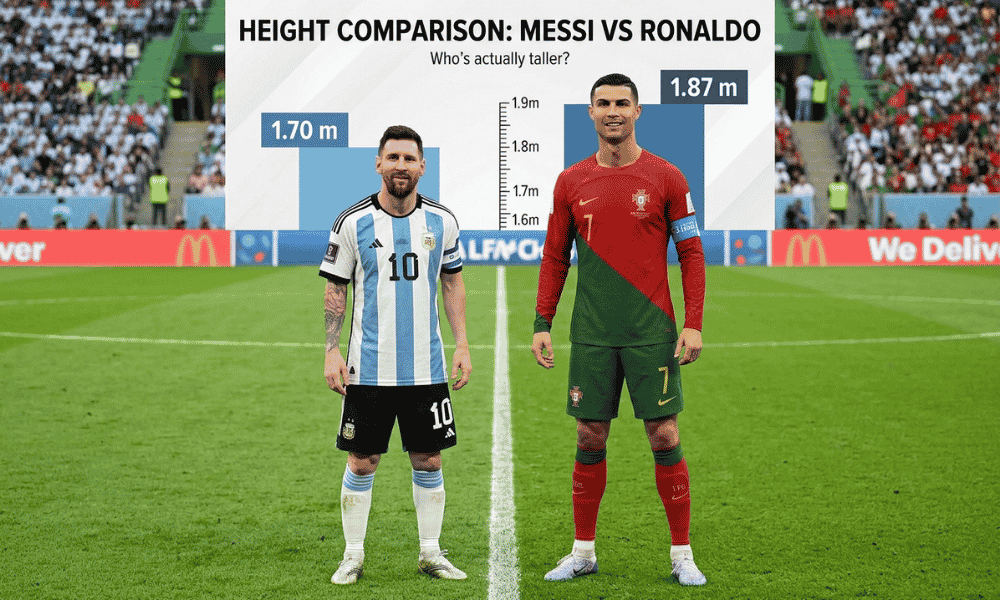
Some matchups became famous specifically because of the size gap. Ronaldo stands about 17 centimeters taller than his longtime rival Messi, a height difference fans could clearly see every time the two shared a pitch. More recently, comparisons between Haaland and Messi have become a shorthand for two completely different approaches to scoring goals, one built on power and reach, the other on precision and close control.
These rivalries are part of why a football players height comparison generates so much search interest. People are not just curious about numbers; they want to understand how two contrasting body types can both reach the top of the same sport.
When Height Actually Decides Outcomes
Height matters most in set pieces, aerial duels, and one-on-one physical battles near the box. It matters far less in open play, where balance, technique, and decision-making usually outweigh raw size. This is the real takeaway from any serious football players height comparison: height is one variable among many, not a guarantee of success or a disqualifying weakness.
Scouts and coaches who obsess purely over height risk overlooking technically gifted shorter players, while teams that ignore height entirely can get exposed on corners and crosses. The best squads balance both.
Key Takeaways
- A football players height comparison shows real variation by position, with goalkeepers and center-backs trending tallest and creative midfielders and wingers trending shortest.
- Erling Haaland and Virgil van Dijk represent the taller end of elite football, both around 193 to 195 cm.
- Lionel Messi, at 170 cm, remains proof that height is not a requirement for greatness in football.
- Height gives a clear edge in aerial duels and set pieces but matters less during open play and technical dribbling.
- League and country averages differ slightly, but individual skill consistently outweighs raw physical size at the highest level.
Whatever angle you come at it from, a football players height comparison ultimately tells the same story: the sport rewards more than one body type, and the best players learn to turn their build, tall or short, into an advantage.
FAQ: Football Players Height Comparison
Who is the tallest footballer currently playing at the top level? Erling Haaland is among the tallest elite forwards in the world today, listed at roughly 195 cm (6’5″). Center-backs and goalkeepers often measure similarly tall or taller, since those positions favor height for aerial duels.
Who is the shortest famous footballer? Lionel Messi, at 170 cm (5’7″), is one of the shortest players to reach the very top of the sport. Diego Maradona, at around 165 cm, was even shorter and is often cited in the same conversation.
Does height actually affect performance in football? Yes, but only in certain situations. Height gives a clear advantage in aerial duels, corners, and one-on-one physical battles near the box. It matters far less during open play, dribbling, and quick changes of direction, where technique and balance tend to win out.
What is the average height of a professional footballer? Across most top leagues, the average sits around 181 to 183 cm, though this varies by position. Goalkeepers and center-backs push that average up, while creative midfielders and wingers often bring it down.
Why do goalkeepers tend to be taller than other players? Goalkeepers need maximum reach to cover the goal frame without relying purely on reflexes. Clubs rarely develop shorter goalkeepers past academy level, even when they show strong reflexes and shot-stopping ability, because reach becomes a limiting factor at higher levels.
Are shorter players at a disadvantage in football? Not necessarily. Shorter players often have a lower center of gravity, which helps with quick direction changes, tight ball control, and shielding the ball under pressure. Many of the most technically gifted players in history have been on the shorter side.
How does height compare between different national teams? Squads from Northern European countries tend to average taller overall, reflecting general population trends, while squads from South America and parts of Southern Europe often average shorter but rely more on technical skill. Exceptions exist on every team.
Is height a factor scouts actually consider when signing players? Yes, especially for goalkeepers, center-backs, and target forwards, where physical presence directly supports the role. For technical positions like attacking midfield or winger, scouts weigh skill and decision-making more heavily than raw height.